
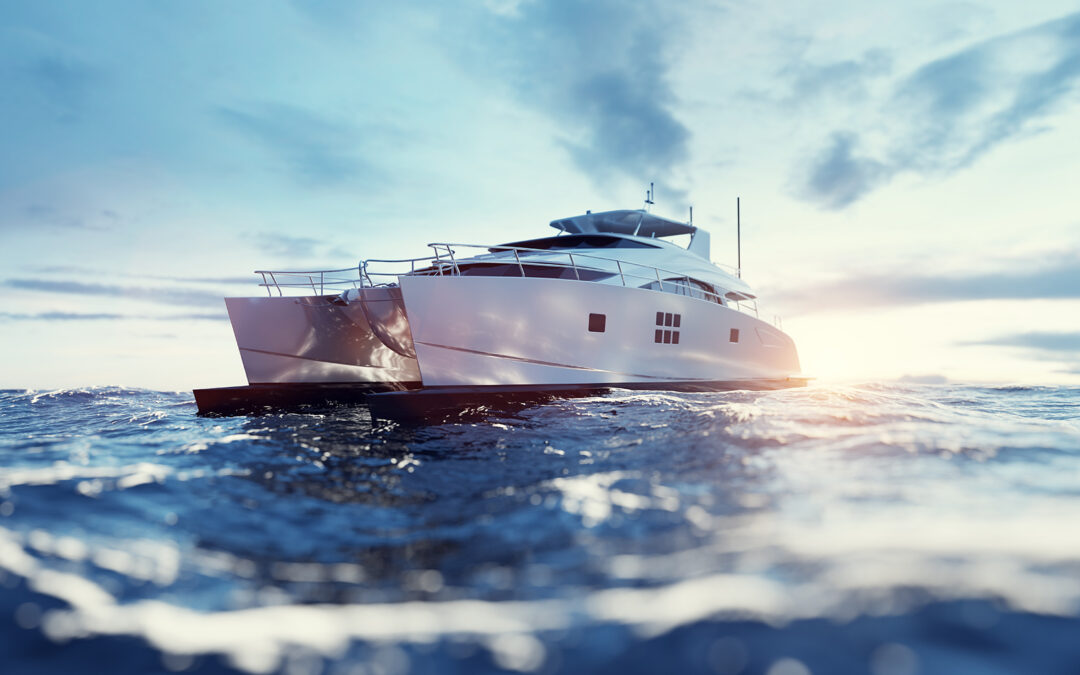
Every so often a project comes along that pulls together everything a business has learned and puts it into practice at once. For Full Power, that project is S/Y Desert Rose.
Desert Rose is a Lagoon catamaran currently undergoing a complete hybrid-energy transformation, and it is one of the most ambitious builds Full Power has taken on. It is not a single upgrade or a new battery bank bolted onto an existing system. It is a full rethink of how the vessel generates, stores, manages and uses power.
The project brings together large-scale lithium energy storage, high-output charging systems, advanced power management and electric propulsion technology. The goal is straightforward to state and genuinely difficult to deliver: dramatically increase energy efficiency while reducing dependence on traditional diesel-powered generation.
To understand why this matters, it helps to look at how far charging technology has come. Not long ago, onboard charging systems were typically measured in a few kilowatts, enough to slowly top up a modest battery bank over hours of generator run time. Desert Rose is being fitted with modern high-power charging architecture capable of recovering a significant amount of energy in a fraction of that time. That difference changes what is possible on board, from how long you can run without the generator to how quickly you can recover after a heavy day of use.
For Oliver Cridge, founder of Full Power, projects like this represent the next stage in marine energy rather than simply a bigger version of what came before. The focus is not on generating more power for its own sake. It is on capturing energy more effectively, storing it more efficiently and using it more intelligently across every system on board.
The practical results speak for themselves. Quieter operation, because the generator runs less. Lower fuel consumption and reduced maintenance costs, because engines and generators are not being asked to work as hard. Greater onboard comfort, because power is available when it is needed rather than rationed around generator schedules. And perhaps most importantly, greater independence from shore-based infrastructure, which matters whether you are anchored in a remote bay or crossing an ocean.
Desert Rose is still underway, and there is more to share as the build progresses. But the direction is already clear. This is what marine energy looks like when it is built around efficiency and redundancy from the ground up, rather than added on as an afterthought.
If you are considering a similar transformation for your own vessel, we would welcome the chance to discuss what is possible.